The Power of Silence
There is a lack of silence in today’s music.
There, I said it.
Being a music producer and a classically trained musician, my observation is that there are two types of lack of silence, and I suspect that it is linked to the way mainstream music has become, following trends — especially TikTok and their relationship with music.
Silence And Music Production
The most noticeable lack of silence is the kind no longer found in music production. Now, I know what my fellow music producers would say, the trends say we need tight production, there shouldn’t feel any emptiness when you mix.
I actually disagree with that. Stripping down so not all frequencies on an EQ are maxxed out feels like the track can breathe. I do blame the trend of overproduction in K-pop for that. Don’t get me wrong, I do like K-pop. I enjoy Stray Kids the most out of every group out there, and its leader Bang Chan, who is part of the production unit 3RACHA, knows what he is doing and I learn a lot about music production from analysing the group’s songs.
But I feel like K-pop music producers nowadays layer track after track, making sure not to leave a single bit of silence within the song. perhaps it’s just me and my musician ears, but the lack of silence overwhelms my brain after a while.
By silence in this context, I mean the opposite of filling the space in music production. When you mix a song, you pan your instruments and vocals so that each sits in a different part of the stereo bandwidth and they don’t overlap each other. Think of it as making sure you can see everyone when you take a photo; you don’t want someone to be half hidden by someone else’s head, you want to make sure each face is visible and you place the tallest people in the back and the shortest in the front. The same concept is used for mixing, except in this case it’s instruments and vocals, and you apply EQ to them to highlight their best frequencies based on what kind of sound you’re looking for. At the end of the day, if you have a lot of tracks on your DAW (Digital Audio Workstation, for those who haven’t heard the terminology before!), you’ll need precision to make sure they don’t come out sounding muddy, like overlapping in both frequencies and place in the mix — and it is even harder if you use surround sound mixing like for Dolby Atmos.
But because of that precision and the amount of layered tracks you have — I have seen some projects with over a hundred and twenty tracks! My personal maximum sits around fifty-five, for reference — when you’re mixing, there is less and less space remaining in the song’s frequencies and stereo bandwidth, which is the equivalent of a subway car filled to the brink during rush hour. The result, if you know what you’re doing, is a well mixed song but with no silence at all, just sound that can turn like noise in your brain if you’re as sensitive as I am.
Now compare it to classical music, or some anime soundtracks that let things breathe — I say some, because some composers also forgo their classical music training and follow mainstream music production methods for high intensity pieces, like for action scenes; the same applies to Hollywood music composers, from my observation they too follow the trend of a tight production. Silence in how the mixing is done exists. The soundtrack breathes. Classical music, though elaborate and sometimes complex to the ear, still possesses that sense of silence.
Perhaps I should provide an example. Consider this soundtrack from the Demon Slayer: Mugen Train movie, called News of Rengoku's Death:
(Apologies, I could not find the song from the channel of the original composer, Go Shiina, nor from the studio, ufotable.)
The production is not simple, considering that it is very much orchestral, but there is breathing room in it, where you can feel individual instruments shine before the climax where the orchestra joins in. It allows you to feel the emotions it conveys rather than be overstimulated by the sheer force of the instruments.
It is the same concept that originated in classical music. Even with a full orchestra, the music breathes.
Silence in Music
The second type of silence in music is actual silence. There might be some reverb making the last note echoing like in an empty hall, but it is silence from a musical point of view, for there are no instruments playing.
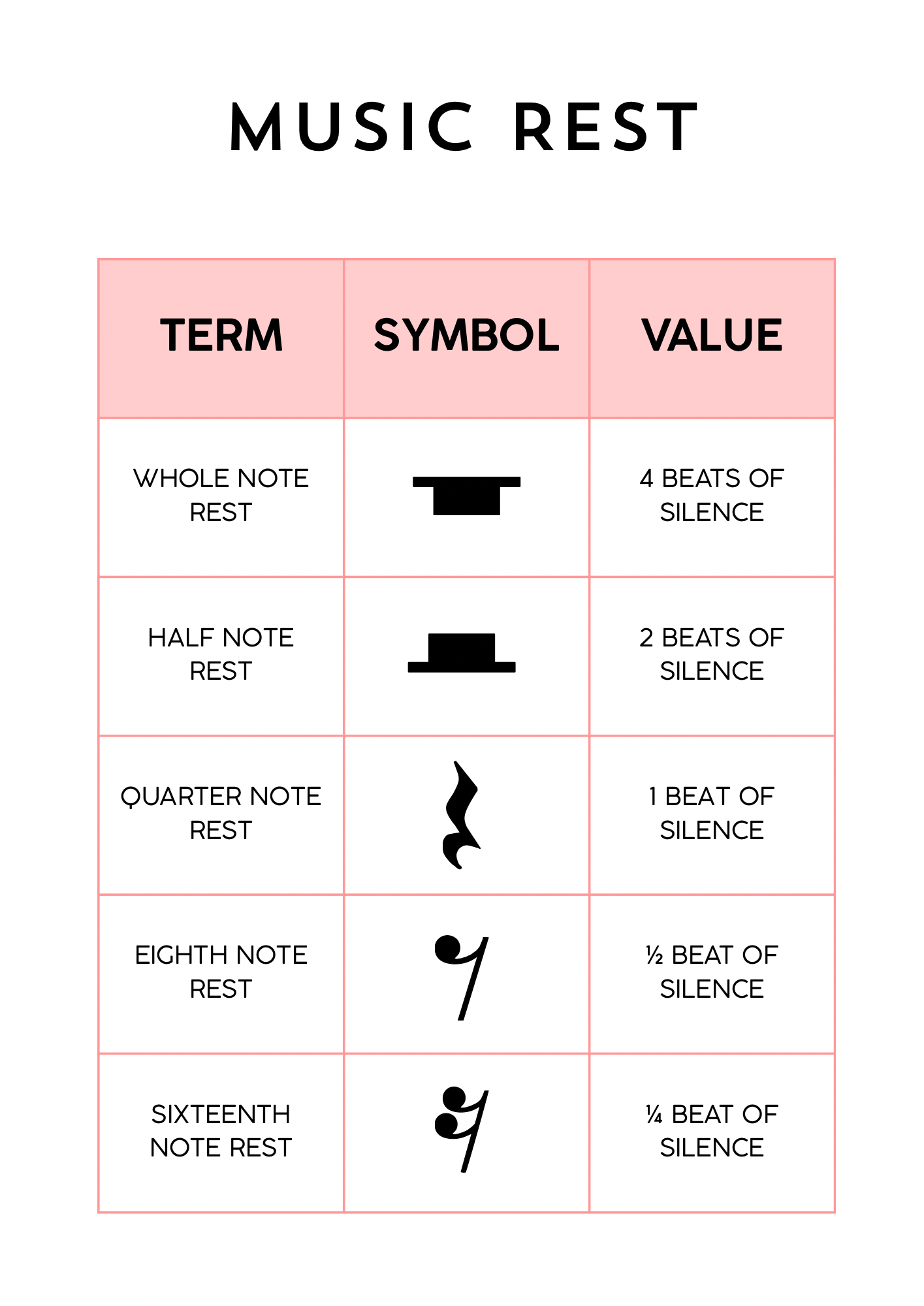 (I know the chart above is kind of daunting for those who don't know or aren't quite fluent with music theory.)
Here is what I have observed. Say you have a whole note rest between sections of a song, that is four beats of silence, even with reverb echoing the last note; a lot of people — not everyone, this is a personal observation — believe that the song is over because silence happens for just a few seconds (depending on the song's beats per minute, or BPM). Even when the music player clearly shows the song is far from over.
As a musician, I enjoy putting silence in music to let the piece breathe between sections, and most of the time it's not just an aesthetic choice, but a storytelling choice and a way to highlight what is coming in the next section. I was making a cover of a My Hero Academia soundtrack a few months ago, and my sections a bit of a storyline in them. To highlight the climax coming in the next section, I added a whole note rest in between on the DAW, it would be one bar of silence). I was really happy with that choice because I felt like it really helped to not only let the piece breathe but it had a purpose. And those who listened to it just removed the headphones when the silence happened and I had to be like "No wait, there's more!"
Perhaps they might have been bored. Who knows? But I did think about it and we barely have any music these days that has any silence in between sections. Instead a beat drop might be used — not that I am complaining of that either, I have used it in my orchestral covers before.
Shortened Attention Span
So why, might you think, do we not have any more silence — both types I described — in our music then? The answer is that we have a shorter attention span. TikTok, Instagram Reels and the likes have made us used to short-form content and thus shorter duration of music. There is a debate online already about the fact that bridges in songs are nearly non-existent, and the trend for song length is currently at two to three minutes on average, with shorter songs being popular on charts, according to this BBC article from last year in 2025. And thus, since we watch short-form content with music that is also starting to become short-form, there is no space for silence in music. Not to mention, with the rise of K-pop, we are seeing artists who layer heavily and use more and more plugins to make songs perfect.
There are exceptions, of course. Soundtrack for games, anime, films and TV shows, for example, don't abide by the rules mainstream music sets for itself. Sometimes, soundtracks are short, sometimes they are ten minutes long, like the full version of Nezuko Kamado's Song, released last year in Go Shiina's latest Demon Slayer original soundtrack album for the Swordsmith Village Arc, which has a duration of eleven minutes and fifteen seconds and has a whole note rest at around 8:43.
(Again, apologies, I could not find the soundtrack on YouTube coming from the official channel of the composer, Go Shiina, nor that of the stdio behind Demon Slayer, ufotable.)
I will give you one mainstream K-pop song by my favourite group, Stray Kids, which does use silence quite effectively, both narratively and aesthetically. Escape, sung by members Hyunjin and Bang Chan as one unit, was released within their single album Mixtape: Dominate on March 21, 2025, and a music video was subsequently unveiled on YouTube on March 24, 2025. At around the 1:39 mark, there is a whole note rest that lets the song breathe, blending in with the R&B vibe of the song, and contributing to the storyline sung in the lyrics by Bang Chan.
There is a lack of silence in today's music, yes; and I do wish more artists would experiment with it again. Maybe one day it might become a new craze, who knows? One can only hope.